What does the motto of the Viennese Secessionists mean? Which artists played a leading role in the Secession? What is the purpose of the Secession today?
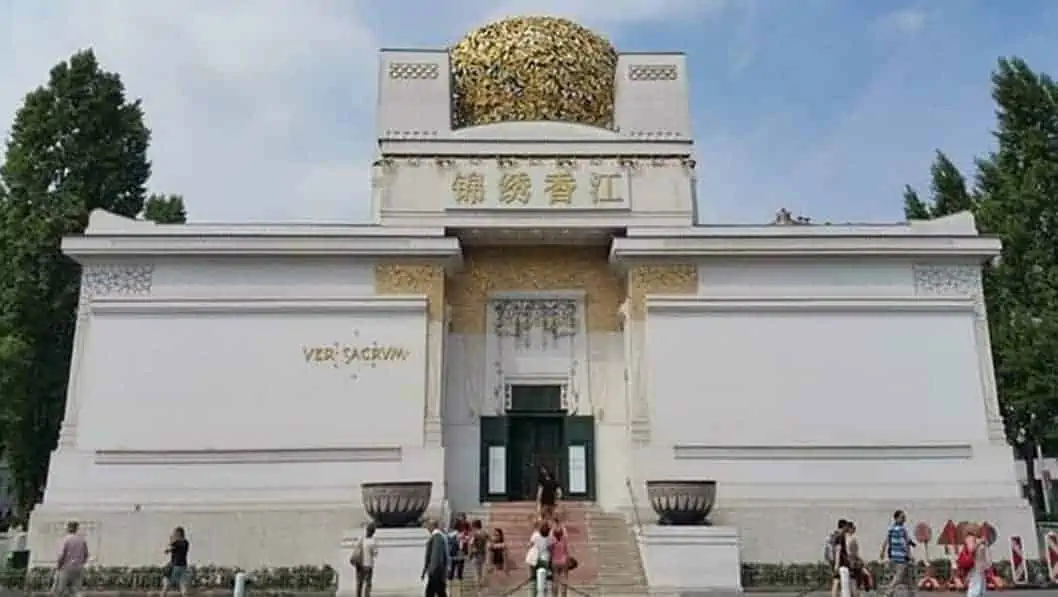
You can read “Der Zeit ihre Kunst – Der Kunst ihre Freiheit” on the outside of the entrance. What would Vienna be without the Secession and Gustav Klimt?
The Secession: the exhibition building was mockingly called “Krauthappl” (cabbage) by the Viennese because of its appearance. On 1,000m² you can see changing contemporary exhibitions. The Secession also houses a permanent masterpiece by Gustav Klimt: the Beethoven Frieze, a painted setting of Beethoven’s 9th Symphony. It is a 34m long cycle of paintings located in the basement. It was created in 1902, 5 years after Gustav Klimt and other renowned artists split from the conservative Künstlerhaus.
1897 – birth year of Viennese Modernism
1897 was a year of upheaval and is considered the birth year of Viennese Modernism. Gustav Klimt and other artists left the conservative Künstlerhaus and founded a new artists’ association under the name of the
Other well-known artists of the time were Koloman Moser, Josef Hoffmann, Joseph Maria Olbrich (architect of the Secession), Joseph Hofmann, Otto Wagner and Egon Schiele. Vienna had more inhabitants than today, namely 2 million, and was one of the intellectual and artistic centers of Europe. There was a spirit of optimism in the country like never before. Klimt, Schiele, Moser and Wagner contributed significantly to this. Gustav Klimt became world-famous with his painting “The Kiss“. Egon Schiele and the “Portrait of Wally Neuzil” are internationally renowned. Otto Wagner’s buildings are unique in Vienna, from the Postsparkasse to the Stadtbahn with its stations and the church at Steinhof.
No one is more closely associated with the Wiener Werkstätte than Koloman Moser, a universal genius. The period between 1890 and 1918 is known as Viennese Modernism or the golden age of the Secession and represents an interesting period in Austrian history.
Upheaval in art, literature, architecture, music and psychology
The end of the Habsburg dual monarchy was looming and numerous changes were taking place in art, literature, architecture, music and psychology.
Ver Sacrum (Holy Spring) can also be read at the entrance to the Secession building. It was the motto of this new movement, which was based on the Munich Secession . This motto was intended to express the hope for a new art movement, which successfully asserted itself. The
Listening to the 4th movement of Beethoven’s Symphony No. 9 in D minor op. 125 through headphones while viewing the Beethoven Frieze is a special experience. It is a
Time Travel Tip: An interior tour is recommended for Viennese Art Nouveau and Beethoven fans . The Naschmarkt and Karlskirche are located right next to the Secession and can therefore be easily combined. More info: secession Here you will find the top sights in Vienna and further topics about Maria Theresa or Gustav Klimt.
Image source: https://commons.wikimedia.org/wiki/File:Secession_Building_Vienna.jpg?uselang=de