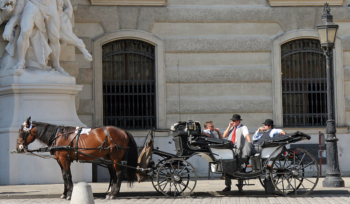
What does the word “Fiaker” mean and where does it come from? How old is the tradition of hackney carriages in Vienna? How many hackney carriage drivers are there today? When does a Viennese like to sit in a horse-drawn carriage? We can look back on around 30 years of hackney carriage history in Vienna. Fiakers are to Vienna what gondolas are to Venice. The hackney carriage consists of three parts: Horses, carriage and coachman.
Where does the term “Fiaker” come from?
The
From “porcelain tours” to city tours
Fiakers always had to be discreet and were also secretly booked for so-called “porcelain rides” . This was a cautious ride, as if porcelain were being carried. Ladies and gentlemen had the opportunity to enjoy themselves in the closed cabin. Since the First World War, hackney carriages in Vienna have mainly been hired by locals for city tours (international guests), visits to the Prater (popular for confirmations) and special occasions (e.g. weddings).
The first female coachmen were introduced in 1984 and the prices for the tours are set by the City of Vienna. Traditional clothing is also regulated by law. Since 1998, a driving test has been required in Vienna in order to work as a horse-drawn carriage driver. Today, there are around 40 hackney carriage companies with 200 hackney carriages in Vienna. Many of these carriages are now over 100 years old.
To get a better impression of old carriages and the entire fleet of vehicles of the Habsburg dynasty, we recommend a visit to the Wagenburg next to Schönbrunn Palace.
There is even a Fiaker coffee among the 40 or so Viennese coffee specialties . This is a drink that consists of half black coffee and half whipped cream and is refined with rum .
There are several hackney carriage stands in Vienna, e.g. at Albertinaplatz, Michaelerplatz, Stephansplatz, Petersplatz and Burgtheater/Volksgarten . For a short tour (approx. 20 minutes) through the city center, you can expect to pay around €55, while a long tour (approx. 40 minutes) also includes the Ringstrasse and will set you back €80. Four people fit in one carriage, so you can easily share the costs. Individual tours can also be booked. The Central Cemetery can also be explored in a horse-drawn carriage, just like in imperial times.
There are now also guided tours of the stables to learn more about the horses, the hackney carriages and their profession. For those who want something more elegant and with dinner, we recommend the Riding Dinner www.ridingdinner.com
Time Travel Tip: Right next to Time Travel , you can board a horse-drawn carriage at either Michaelerplatz or Petersplatz and get to know Vienna the imperial way.
Image source: https://commons.wikimedia.org/wiki/File:Fiaker_2005.jpg?uselang=de