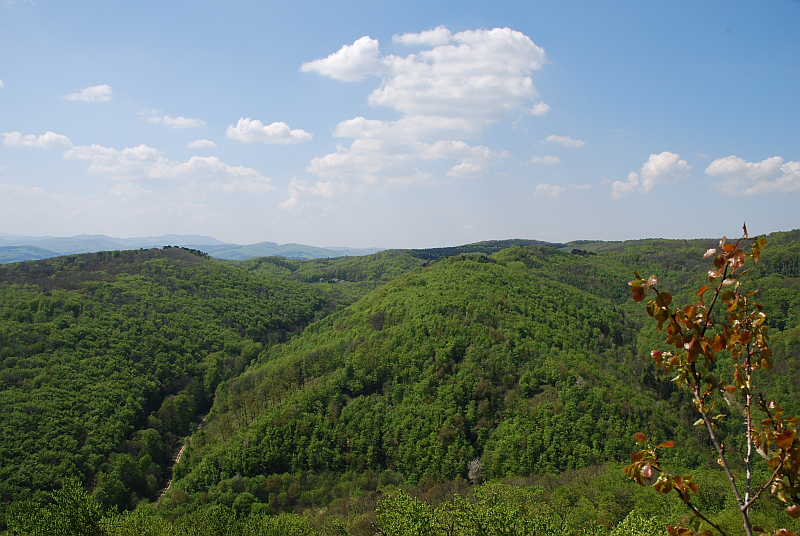
After the First World War, the Viennese moved to the Vienna Woods. They lacked fuel, the winter was cold, and so they simply cut down whatever seemed useful. They came by the thousands, men, women and children, and haphazardly cut everything down. They had no idea of the need for professional slashing and the consequences could not be rectified for a long time. The first Latin name“silva Viennensis” is documented in 1332. The German form of the name“Wienner Waldt” was first used in 1368, when it still went all the way around our city. In 1905, the green belt around Vienna was declared a “forest and meadow belt conservation area” .
Reforestation since 1985
It has always been vital for heating the homes of the Viennese. Most recently during the two world wars. It was not until 1955 that the forest slowly began to recover. Since 1985, the annual reforestation campaign “Wald der jungen WienerInnen” (Forest of the Young Viennese) has taken place in sparsely wooded areas of the city of Vienna. Every year, all interested and committed Viennese are invited to actively participate and contribute to the creation of a new forest. Around 10,000 native trees and shrubs such as oaks, lime trees and maples are planted each year as part of this reforestation campaign. Vienna’s forest grows by 50,000 to 100,000 m² per year.
The Vienna Woods as a unique habitat
The Vienna Woods and the Donau-Auen National Park provide a safe habitat for many animals and plants. The Vienna Woods alone are home to 2,000 plant species, 150 breeding bird species and many other endangered animals. The City of Vienna’s forest management is crucial for the quality of life and essential for supplying the population with drinking water of the highest quality. To this end, MA 49, “Forestry and Agriculture Department of the City of Vienna”, manages water protection and conservation areas in the catchment areas of the 1st and 2nd High Spring Pipelines. The department manages a total area of around 33,000 hectares of forest, alpine pastures, meadows and water bodies in the Rax and Schneeberg regions and in the Hochschwab massif. This makes Vienna the largest agricultural enterprise in Austria! The Viennese are thus guaranteed the natural luxury of spring water from the tap.
With a forest cover of around 20 percent of the city area, Vienna is one of the greenest cities in Europe and the only one with its own national park. In 2016, our city was awarded the honorary title of “European Forest City”.
Time Travel Tip: Vienna now offers 10 city hiking trails through the Vienna Woods and it is well worth exploring the city on them. There is even a so-called “Rundumadumweg”, where you can walk around the city in a circle. Make sure you have enough time, as it is about 120 km long.
More info: Vienna city hiking trails
Image source: https://commons.wikimedia.org/wiki/File:Wienerwald34.jpg