When was Vienna’s famous Ringstrasse built and which architects were involved? In what style is Vienna’s most important traffic artery designed? Why does it have this name?
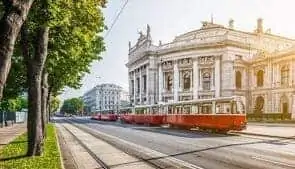
The approximately 5 km long Vienna Ringstrasse, the magnificent 19th century boulevard that surrounds Vienna’s city center , was built between around 1860 and 1910 . It was intended as the most important traffic artery and was mainly used for strolling . Many cafés, hotels and the most beautiful palaces lined and still line the Ringstrasse. Special events take place on the Ringstrasse, be it rallies or parades, and the Vienna City Marathon also chooses the Ring as a beautiful running route. Vienna’s Ringstrasse looks like a ring that encircles the city center, although strictly speaking it is shaped like a horseshoe .
The architecture of the buildings can be traced back to renowned architects such as Theophil von Hansen, Gottfried Semper, Carl von Hasenauer and Heinrich von Ferstel . The style used is called historicism, i.e. no new style was invented, but the earlier styles were used. The State Opera Houseis built in the neo-Renaissance style , the Vienna City Hall is neo-Gothic.
Streetcars no. 1 and 2 (change at the State Opera or Schwedenplatz) show you the Ringstrasse with its magnificent buildings starting at Stubenring: Former Ministry of War (now home to various ministries) – opposite the Otto Wagner Postsparkasse – University of Applied Arts – Museum of Applied Arts (MAK) – Palais Coburg – Stadtpark – Hotel Imperial – State Opera – Hofburg with Burgtor and Heldenplatz – Art and Natural History Museum – Maria Theresa statue in between – Museumsquartier (MQ) behind it – Parliament – Volksgarten – Town Hall with park and square in front of it – Burgtheater – University – Mölker Bastei (part of the old city fortifications) – Votivkirche – Deutschmeisterdenkmal – former stock exchange building – Ringturm – Franz Josephs-Kai – Danube Canal – (view to the right of the Ruprechtskirche) – Schwedenplatz – Urania – view of the Giant Ferris Wheel in the distance – Stubenring.
After a complete tour (takes approx. 30 minutes), you can get off again at Schwedenplatz and try Vienna’s biggest schnitzel nearby at the “Figlmüller” ! Please note: reservations are essential! Afterwards we recommend a digestive walk through the “Bermuda Triangle”, where you will also find the Jewish synagogue and the Ruprechtskirche, the oldest church in Vienna . Numerous pubs invite you for a drink or two. You can easily get lost in the Bermuda Triangle, they say 😉
Where the Vienna Ringstrasse is located today, there used to be until the middle of the 19th century. the city wall. The Napoleon’s French occupying troops blew up the castle at the beginning of the 19th century. the Vienna city wall between Löwelbastei and Augustinerbastei, which meant that the idea of a fortification was cracked in the truest sense of the word.
However, it was another 50 years before the handwritten letter expressed Emperor Franz Josef’s intention to demolish the city walls and replace them with the famous Ringstrasse.
The city walls were no longer useful for military purposes and good profits could be made from the expensive glacis grounds (green parade grounds in front of the city walls). Systematic demolition began in 1858, starting with the Rotenturmtor.
In addition to several street, alley and square names(Stubenbastei, Dominikanerbastei, Coburg- and Schottenbastei as well as Rotenturmstraße and Werdertorgasse), public transport stations (Schottentor, Stubentor) are reminders of the old fortifications.
Outer Castle Gate or Heroes’ Gate: This is the only remaining gate of old Vienna, albeit not in its original form. In 1809, Napoleon’s troops blew up the city wall in the area of the Hofburg. As a result, the castle gate was moved to the southwest and rebuilt from 1821-24.
Coburg Bastei: The Palais Coburg has been renovated and converted into a hotel with one of the best wine cellars in Vienna. Remains of the fortifications from the 16th century. are displayed there. Today, events are held in the casemates, the underground fortress vaults.
Mölkerbastei: Only the connecting wall to the former Löwelbastei remains. They did not want to demolish it because of the Pasqualatihaus and the Dreimäderlhaus, which are located on top of it.
Albertina: The higher Albertina is still reminiscent of the Augustinerbastei.
Dominikanerbastei: Only the form remains here, but not a single piece of stone from the original wall.
Stubenbastei: At the Stubentor subway station you can still see parts of the old Renaissance wall.
Ruprechtskirche: Here, too, you can still see a tiny part of the old city wall.
Time Travel Tip: You can also take a trip around the Ring on the old historic Vienna Ring Tram . Audio guides are available in several languages and explain what you are seeing!
A more classic and slightly more expensive option would be a ride in a horse-drawn carriage along the most beautiful buildings on the Ringstrasse. Four people fit in one carriage, so the costs can be shared. The Viennese like to travel in a horse-drawn carriage on special occasions, be it a wedding, birthday, first communion etc.
At Time Travel itself, you can get a taste of Vienna’s Ringstrasse in the
last stop on the Fiakerflug! More will not be revealed here 😉
More info: www.wienerlinien.at