Ludwig van Beethoven was, as most people know, a very well-known composer who lived here in Vienna. But he also had another side, namely that of a womanizer. There was an incident with a 16-year-old girl which he himself reported to the police. But what really happened at this piano lesson with Count Mangold’s daughter?
The power and deep musicality of his world-famous works testify to great inner strength, depth of character and an almost unbridled temperament . The genius repeatedly accepted commissions from aristocrats for their sons and daughters, who did not always have a talent for subtle piano playing.
Count Mangold’s daughter was someone without hearing or sensitivity. She struck the wrong notes on the innocent keys and Beethoven’s already extremely sensitive hearing suffered agony during the ordeal. The composer spent a large part of each piano lesson in an adjoining room. He simply could no longer bear the misery of the sounds.
Beethoven decided to convince his patron of the absurdity of any further piano lessons with his daughter. The atonal playing stopped abruptly. The musician listened for a while and then entered the room to check on his pupil. When he opened the door, he stood rooted to the spot. The
The thwarted pianist obviously had other advantages. Her flawless body, rather boyish, small firm breasts, soft white skin. She was actually exactly the type of woman that suited
He quickly leaves his apartment in Mölkerbastei and hurries to the nearest police station to report the incident. The officers are skeptical about what he has to say. He had already attracted attention for his quick-tempered nature. He had had an argument with the janitor of his apartment. Her son had forced Beethoven to pull him by the ears when he shouted loudly and persistently while he was composing. This woman was sitting with a friend in the anteroom of the office to record her observations of a theft. “What’s Beethoven doing here?” She was curious, knew one of the police officers and was told that he had come to the station on his own initiative because of a story involving a 16-year-old schoolgirl.
One of the most famous composers of the Viennese classical period therefore had regular dealings with the Viennese security authorities, as he was described as unruly, affective and raving mad in some life situations. Another of the artist’s personal problems was the fact that he was unable to establish a stable relationship with a woman with a view to marriage.
Many women admired the musician and loved him, but none of the mostly aristocratic ladies could decide to marry him. Ludwig van Beethoven had a very intimate relationship with
The genius cultivated one of his most intimate relationships with Countess Julie von Guicciardi , which did not lead to marriage due to the differences in status. The noblewoman later married Count von
Gallenberg, but remained on friendly terms with Beethoven and, as an almost publicized affair showed, even closer:
On a balmy evening, a carriage bumps along the dusty streets of the suburb of Wieden. An uncle of Count Gallenberg and his cousin Countess Julie are riding to their estate. The horses spook, the carriage veers off the road and gets caught in the undergrowth. Fortunately, nothing happens, the passengers get out and stroll a little in the adjacent forest. The coachman would call them as soon as the journey continued. The two blue-blooded gentlemen approach a clearing and can’t believe their eyes. Ludwig van Beethoven and the newly married Julie von Guicciardi are lying there on a blanket in love on the grass
The composer was accused of marital disturbance and Emperor Franz I, who was well-disposed towards him, found out about this affair. Ludwig van Beethoven was very popular in his day. The Emperor knew this and officially made the affair disappear. The affair was slowly forgotten. Franz I instructed his aide-de-camp to carefully convey to the musician that any affairs with women should take place outside Vienna.
Time Travel Tip: You can find out more about Beethoven’s life and work in Vienna at the following locations: Vienna Museum Beethoven Pasqualatihaus, Beethoven Museum Heiligenstadt.
More info: Beethoven Pasqualatihaus: WIEN MUSEUM
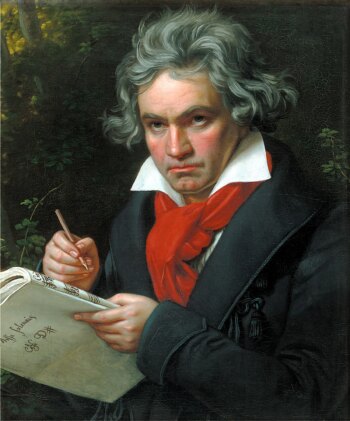
Image source: https://commons.wikimedia.org/wiki/File:Beethoven.jpg?uselang=de