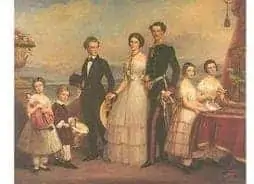
Some of Sisi’s siblings had funny names: Ludwig (called Louis), Helene (called Nené), Carl Theodor (called Gackel), Marie, Mathilde (called Spatz), Sophie and the baby Max Emanuel (called Mapperl). Elisabeth was the third child of eight children from the marriage between Princess Maria Ludovika (1808-1892) and Duke Maximilian in Bavaria (1808-1888). The parents did not exactly have a model marriage; the father had several illegitimate children. The elder brother was Ludwig Wilhelm Duke in Bavaria (1831-1920), who renounced his first-born rights in favor of a middle-class actress named Henriette Mendl. He was successful in the military, reaching the rank of cavalry general. His daughter Marie Louise Mendl later went down in history as Marie Louise von Larisch-Wallersee. She knew more about the Mayerling tragedy. Elisabeth had a close relationship with her older sister Helene (1834-1890), known as Néné, throughout her life. Despite the scandal in Bad Ischl when Emperor Franz Joseph chose the young Sisi as her future wife. Néné thought she was meant to be. At the age of 22, Helene also married the hereditary prince Maximilian Anton von Thurn und Taxis . It must have been a good marriage, unlike the younger sisters. Unfortunately, the marriage did not last very long, as Maximilian died of a serious kidney ailment at the age of just 35. They had four children, for whom she took over guardianship. Helene died of an abdominal ailment at the age of 56. Elisabeth was brought up together with her sister Helene, called Néné, who was three and a half years older. An Englishwoman acted as governess and looked after the girls for four years. Just how formative this time was is shown by the fact that the duchesses used English as their secret language until the end of their lives. Despite the embarrassment of her choice of bride, Helene remained a close confidante to Sisi throughout her life. Even in difficult times, she always had a positive influence on her younger sister. Sisi had a special relationship with her younger brother Carl Theodor (1839-1909). He later became a well-known ophthalmologist . He founded the private Herzog Carl Theodor Eye Clinic in Munich and performed around 5,000 cataract operations. Elisabeth’s younger sister Sophie (1847-1897) was only 50 years old and had a fateful life. Initially, she had several suitors, including Duke Philipp of Württemberg, Prince Louis of Portugal and Ludwig Viktor from Austria, who was, however, homosexual. Her cousin and childhood friend Ludwig II was also considered a candidate, but he broke off the engagement. They married Ferdinand von Alecon, who was a grandson of the last French king, and lived in exile in England, where Sophie did not feel very comfortable. Sophie had a son and shortly afterwards they moved to France. Sophie began to suffer from depression and ended up in a mental hospital, which she was able to leave seven months later as cured. She died a tragic death during a fire in Paris. Another of Elisabeth’s younger sisters was Marie Sophie Amalie, Duchess of Bavaria (1841- 1925). She was the last queen of both Sicilies through her marriage to Crown Prince Franz, whose father was King Ferdinand II. He soon died and his son Franz was in principle incapable of ruling. The events of the time forced her to flee the declining kingdom into exile in Rome in 1861. Marie repeatedly caused a stir and provocation. In 1862, she secretly gave birth to a daughter, whom she gave up for adoption. She later confessed this misstep to her husband. She was in competition with Sisi, especially when it came to riding. The two did not get on particularly well. The next younger sister was Duchess Mathilde Ludovika in Bavaria (1843-1925). She got on very well with Marie Sophie, as she was married to Count Ludwig von Trani, who was the younger brother of the King of both Sicilies. The marriage was unhappy and she separated from him. Mathilde was called “Sparrow” because of her squeaky voice. The youngest brother was Maximilian Emanuel in Bavaria (1849-1893), who devoted himself to the military and died relatively young at the age of 44 from a severe gastric hemorrhage. Time Travel Tip: You can find out more about the life of Empress Elisabeth and her siblings at the Sisi-Mseum. More info: Sisi Museum – Hofburg Vienna (hofburg-wien.at)
Image source:
https://de.m.wikipedia.org/wiki/Datei:Geschwister_der_Kaiserin_Elisabeth_von_%C3%96sterreich_auf_der_Veranda_des_Schlosses_Possenhofen.jpg