
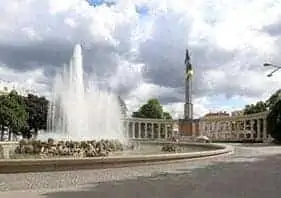
Vienna’s water is known for its excellent quality. What makes the water supply in Vienna so unique? What does the Viennese high-jet fountain on Schwarzenbergplatz stand for?
In Vienna, high spring water from the Alps is delivered directly to the household . Vienna’s water comes from Lower Austria and Styria and flows down a natural gradient without pumps to the capital, where it arrives around 36 hours later. The water then has approx. . 180 km covered.
Schneeberg, Rax and the Schneealpe feed the I. Hochquellenleitung, the Hochschwab the II. High spring pipeline. Due to the strict spring protection, the water no longer needs to be treated and flows partly in underground pipes to Vienna. Due to the natural gradient of long stretches of 0.22 per thousand, the gravitational energy along the pipes is even used to generate electricity and can supply a small town.
I. and II. Vienna High Spring Pipeline
After four years of construction, the first Vienna High Spring Pipeline was put into operation on October 24, 1873 in the presence of Emperor Franz Joseph . The
The II. Wiener Hochquellenleitung is fed from the Hochschwab region in Styria and serves to reinforce the I. pipeline. It was built in 1910 and transports approx. 217 million liters. It measures approx. 180 km and overcomes height differences of 360 meters.
The water tower in Favoriten is a reminder of the II. The water tower in Favoriten is reminiscent of the second line, as water used to be stored there. Nowadays, the water tower serves as an observation tower and event location. The adjoining water playground is very popular in summer and is a great place to cool off.
Vienna was the first city in the world to place drinking water under constitutional protection.
Time Travel Tip: Every good Viennese coffee house automatically serves a glass of Viennese tap water with your coffee.
You can find a recommendation of Viennese coffee houses in this blog post: Viennese coffee houses