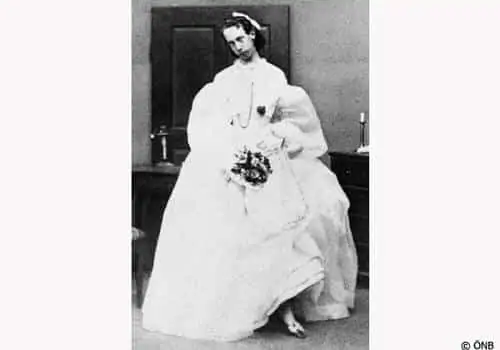
A Habsburg is totally out of character, be it through his lifestyle, his way of dressing, his involuntary place of residence and at the same time the place of his final resting place. So who was Luziwuzi, as he was affectionately called by the family, and why did he like to wear women’s clothes?
In every family there are outsiders, eccentric eccentrics, black sheep and we can definitely count Archduke Ludwig Viktor of Habsburg-Lorraine, known as Luziwuzi, the youngest brother of Emperor Franz Joseph, among them. His remains are not in the Capuchin crypt in Vienna, where most Habsburgs rest, but in the municipality of Siezenheim, near the city of Salzburg, in a simple grave with an inconspicuous memorial stone with the intertwined letters LV, deceased on January 18, 1919. But first let’s take a look at his childhood and youth and how everything developed. He was born on May 15, 1842 in Vienna as the youngest son of Archduke Franz Karl and his wife Sophie. He was actually supposed to be a girl, as there were already three sons and a girl died in between at the age of four. As the baby of the family, he was given a certain “fool’s freedom” for a long time, as he liked to be the center of attention and wanted to be noticed. He was also known for his sharp tongue. He must have realized early on that he had a different orientation to his brothers and his mother must have sensed this too, as he was not given a “hygiene lady”, as was customary with the other young arch-hereditary figures, in order to teach them the vital form of procreation. With Luziwuzi it was different, handsome young men ran after him to offer themselves to him, or perhaps to hope for an imperial reward? Even in his youth, he was passionate about going to the theater, opera and ballet. He also began to collect works of art like many of his ancestors. The enfant terrible loved noisy parties, major social events, overdressed ladies and varied evening entertainment. He himself also appeared on theater stages in women’s clothing. The scandals piled up, there were reports of certain incidents on the Prater Hauptallee with horse-drawn carriage drivers, and there was some excitement at the seaside resort of Abbazia (now Opatija), because Luziwuzi lived out his disposition in a relatively relaxed and self-confident manner. The construction of the Ringstrasse and the many new palaces contributed even more to his self-image. The young star architect Ferstel built one of the most important Renaissance-style Ringstrasse palaces for Luziwuzi at number 1 Schwarzenbergplatz. Later, the military science casino association moved in there and today it is also one of the venues of the Burgtheater “Kasino am Schwarzenbergplatz”. Here it was able to more than represent itself with an open staircase, gallery, ballroom and banqueting hall, conservatory, dining room and tower cabinet. Even the drainpipes of the toilets are said to have been made of Untersberg marble. Only there was no swimming pool. He therefore liked to visit a public bathing establishment twice a week accompanied by an aide. This was all done in secret, of course, as it would not have been tolerated in court society. What really happened in this bath at that time is described in many variations. The fact is that he got a resounding slap in the face in front of many witnesses when he made a brazen and lewd hand gesture towards a handsome young man. This incident broke the camel’s back and he had to appear before his eldest brother, Emperor Franz Joseph. The outcome of this conversation was Luziwuzi’s deportation to Schloss Kleßheim in Salzburg. But as unpopular as he had been in Vienna, he became popular in Salzburg because he did so much for the people. Right next to Kleßheim Castle was a state sanatorium for the mentally ill, where he was later committed and incapacitated. He was ill for a long time and died of pneumonia at the age of 76. Only his niece Marie Valerie, Sisi’s favorite daughter, was the only Habsburg to come to his deathbed.
Here you will find the top sights in Vienna and more topics about Maria Theresa or Gustav Klimt.