Where was Franz Schubert born and how old was he? What did he die of? What was the story behind his glasses? How did he live and what did he leave behind for posterity? Who did he want to be buried next to?
On January 31, 1797 , Franz Peter Schubert was born at Nußdorfer Straße 54 (on Himmelpfortgrund). The house where he was born can still be visited today, as can the house where he died in Kettenbrückengasse in the 4th district. Both are run by the Vienna Museum Vienna Museum.
His father was a schoolmaster and taught him to play the violin at the tender age of five . He received
Because of his beautiful voice, he joined the choirboys . There he also received lessons from Antonio Salieri and met long-time friends such as Joseph von Spaun, Albert Stadler and Anton Holzapfel . His talent lay in composition, as soon became apparent.
For his father’s sake, he initially began working for him as a school assistant, but soon realized that this was not his direction. He preferred to compose works such as “Gretchen am Spinnrad”, “Heideröslein ” and“Erlkönig“.
A life full of music and friends
His father was not very empathetic and Schubert’s friends became his family. He left home early and always lived in shared flats. He was not good at being alone. He maintained a close friendship with Franz von Schober in particular. He created a dream world for himself with his music.
His circle of friends continued to expand, e.g. to include the Kupelwieser brothers and Moritz von Schwind . The musical Sonnleithner family organized musical gatherings in his honour, which from 1821 culminated in the Schubertiades that are still known today.
Schubert was prone to alcohol consumption and obesity , which had a negative effect on his health. He suffered from a venereal disease, the dreaded syphillis , and was treated for ulcers at the AKH in 1823.
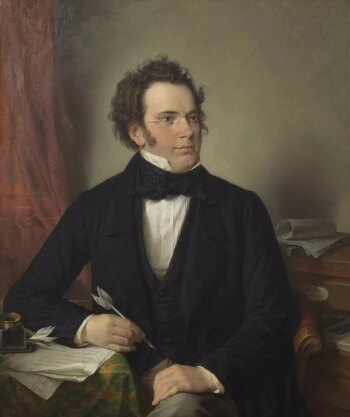
In 1824 , he composed the famous song cycle “Die schöne Müllerin”. One of Schubert’s peculiarities was his glasses, which he allegedly did not even take off at night to sleep, as he always wanted to have them ready to hand for composing.
Franz Schubert died on November 19, 1829 in the house of his brother Ferdinand in Kettenbrückengasse. The house where he died can still be visited today. He suffered from syphillis, but the cause of death was probably typhoid fever .
Franz Schubert was only 31 years old and in this short time he was very productive. He left behind over 600 songs, choral music, overtures and symphonies. He said of himself: “He was only born to compose and nothing else“.
An unrecognized genius
Compared to Beethoven, Haydn and Mozart , Schubert is often considered an unrecognized genius. He did not achieve the impact with his symphonies and operas as he did not seek publicity. Persuaded by his friends, he gave a concert in 1827 that was very successful. His masterpiece was the 600 Lieder, in which he turned poetry into music.
He was a great admirer of Beethoven and wanted to be buried next to him. Both were initially buried at Währing Cemetery and later both were given a grave of honor next to each other at Vienna Central Cemetery.
In the Stadtpark you will find a monument to Schubert . Moritz von Schwind created a Schubert lunette in the State Opera House . The Schubert-Ring in the first district, Schubertgasse in the 9th district and Franz-Schubertgasse in the 14th district were named after him.
Time Travel tip: Visit Franz Schubert’s birthplace at Nußdorfer Straße 54 or his death house at Kettenbrückengasse 6 to gain more insight into his life. Every 1st Sunday of the month you get free admission there !
More info: Schubert birthplace: WIEN MUSEUM
Image sources: https://commons.wikimedia.org/wiki/File:Franz_Schubert_by_Wilhelm_August_Rieder_1875.jpg