
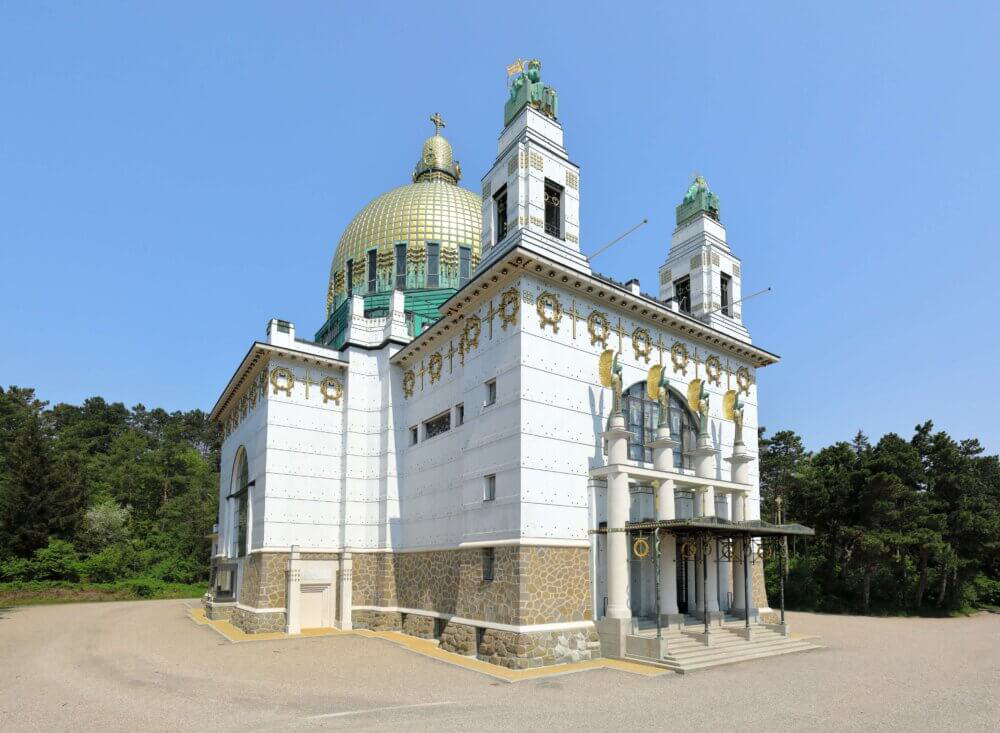
When did Art Nouveau experience its heyday in Europe? Where are its roots? Why is it called that? Why is this style called Secession in Vienna? Which Viennese building can be described as a masterpiece of Art Nouveau?
The roots of Art Nouveau lie in the English “Arts and Craft” movement, which was a response to the industrialization of the 19th century. In England in particular, industrialization began as early as the 18th century. The aim was to preserve the arts and crafts tradition and not to fall completely prey to mass production.
The idea was that art and craftsmanship are not mutually exclusive. A
How do you recognize Art Nouveau?
- Floral decoration (flowers)
- Geometric shapes
- Flowing lines
- Symbolic figures (e.g. eagle, owl, lion)
Art Nouveau experienced its heyday from around 1890 to 1910 and in Germany it is known as Jugendstil, named after the Munich art magazine “Die Jugend”. In the rest of Europe, the art style is called “Art Nouveau” . In Austria, and in Vienna in particular, it is also known as Secession style – after the artists broke away from the traditional, previously predominant style of Historicism in 1897 . This culminated in the construction of the Vienna Secession, an exhibition house whose first president was Gustav Klimt .
The forms and styles also differed throughout Europe. While Art Nouveau tended to be dominated by floral, playful forms (e.g. in Parisian architecture), geometric forms were more dominant in Vienna , angular Art Nouveau. Vienna developed his own formal language in art and architecture, which is present today in museums and on the streets.
Viennese Art Nouveau
Viennese Art Nouveau played an important role in painting, furniture design and the Architecture. Let us first look at the Painting, graphic art, poster design, stage sets and illustration. Gustav Klimt, Egon Schiele, Oskar Kokoschka, Richard Gerstl, Franz Matsch, Carl Moll, Max Kurzweil, Alfred Roller were the most famous representatives of Art Nouveau in Austria. The painters’ works can be admired in numerous Viennese museums(Belvedere, Leopold Museum, Vienna Museum, Secession, Klimt Villa).
When it comes to furniture design , the Museum of Applied Arts (MAK) immediately springs to mind. Here you can marvel at the most beautiful pieces of the Wiener Werkstätte . Founded in 1903 by Josef Hoffmann, Koloman Moser and Fritz Wärndorfer , it went bankrupt in 1932, but you can still see the works in the MAK today. You can also be impressed by Viennese Art Nouveau at the Leopold Museum and the Imperial Furniture Collection .
Art Nouveau in Viennese architecture
In terms of architecture , Art Nouveau is most present in Vienna. Otto Wagner was a pioneer in this field. No one else broke with tradition and shaped the city as much as he did. Much of it has been preserved and is listed today. If Emperor Franz Joseph had not been so conservative, we would have even more Art Nouveau buildings in Vienna. Otto Wagner was only able to realize about half of his plans.
Let’s start on the Ringstrasse. The Vienna Postal Savings Bank is a typical example of the new Art Nouveau style. The building stands directly opposite the former Ministry of War, which was still built in the “old historicist style”. The differences could hardly be more striking. At the
On Karlsplatz we see more buildings by Otto Wagner. His two beautifully decorated pavilions . One serves as a café, the other is dedicated to Otto Wagner and bears witness to his work. The
Along the Linke Wienzeile you will find the former residences of Otto Wagner, where he created a monument to himself . The two house façades next to each other with gilded ornaments and colorful majolica tiles are enchanting to look at. There is also a roof extension by Otto Wagner on Wiener Graben .
Church at Steinhof – Otto Wagner’s masterpiece
The former Stadtbahn and its stations (today U6, U4, S45) also go back to Otto Wagner . His
The church was controversial from the outset. At the opening in October 1907, Emperor Franz Joseph immediately apologized and sent his nephew Archduke Franz Ferdinand instead. According to
The Anchor Clock by Franz Matsch is an important Art Nouveau work of art on the Hoher Markt. A visit to J. & L. Lobmeyr (glass art) on Kärntner Straße is recommended for the purchase of glass art objects . In the Loos Bar on Kärntner Durchgang you can drink cocktails in an Art Nouveau ambience, provided you can find a seat. The bar measures only 4x6m and is always crowded.
Adolf Loos , with his famous Loos House on Michaelerplatz , is also sometimes counted as part of Art Nouveau, although his works could be attributed more to his own Loos style .
The end of Art Nouveau in Austria
The end of Art Nouveau in Austria can be dated to the end of the First World War. 1918 saw the collapse of the monarchy and was also the year in which four important Art Nouveau artists died : Otto Wagner, Gustav Klimt, Koloman Moser and Egon Schiele all died in 1918.
Time Travel Tip: In Vienna, you will encounter Art Nouveau at every turn. It’s worth keeping your eyes open and looking up. A visit to the Art Nouveau toilet on Graben is something special. It is just around the corner from Time Travel and brings the flair of the turn of the century to life in this quiet little place.
Image sources: https://de.m.wikipedia.org/wiki/Datei:Penzing_(Wien)_-_Kirche_am_Steinhof_(7).JPG
_-_Kirche_am_Steinhof_(7).JPG)