What makes Vienna one of the most liveable cities in the world? What is the proportion of green space in Vienna? Which parks are UNESCO World Heritage Sites? Since when has the Prater been open to the public?
In 2019 , Vienna was voted the city with the highest quality of life in the world for the 10th time in a row. Green spaces, which make up almost 50% of the city, play a large part in this. These include the many parks, the Vienna Woods, the vineyards and the agricultural areas.
There are also many parks and gardens in the inner-city area, especially along the Ringstrasse. With industrialization in the 19th century. and the rapid population growth, the green spaces began to be parceled out and a great deal was built on.
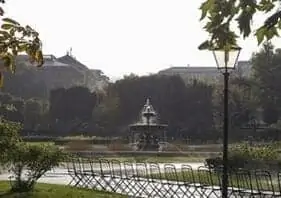
A rapid response from urban planning was the creation of green spaces, as more and more recreational areas were needed for the population. The Volksgarten and Stadtpark are among the first public gardens in the city center. Burggarten and Volksgarten as well as the gardens of Belvedere and Schönbrunn are UNESCO World Heritage Sites.
The Volksgarten was created on the initiative of Emperor Franz II/I. and opened in 1823. Did you know that so-called armchair ladies used to collect money for sitting down here? When the ramparts of the city wall were razed, the park was extended to the Ringstrasse in 1863 and the Rose Parterre was laid out. The Empress Elisabeth Monument followed in 1905.
The Stadtpark is the most monumental park in Vienna and was created in 1862 as part of the Ringstrasse construction project. Here, too, visitors initially had to pay to sit down. Probably the most famous and most photographed monument is located here – the golden Johann Strauss monument.
The Burggarten, which was originally reserved for Emperor Franz Joseph, was opened to the public three years after his death in 1919. His statue, which was only erected here in 1957, can also be found there. The palm house and the butterfly house attract visitors.
The largest park in Vienna, covering around 6 km², is the Prater, a green oasis consisting of meadows and the former hunting grounds of the Habsburgs. First mentioned in documents in 1162, the Prater was opened to the public in 1766. Prater, in Latin “Pratum”, means meadow or pasture.
The baroque parks of Belvedere and Schönbrunn impress with their 18th-century garden art and present their splendor unchanged.
Time Travel Tip: Vienna has many parks in the city center (Volksgarten, Burggarten, Stadtpark) that invite you to take a break.