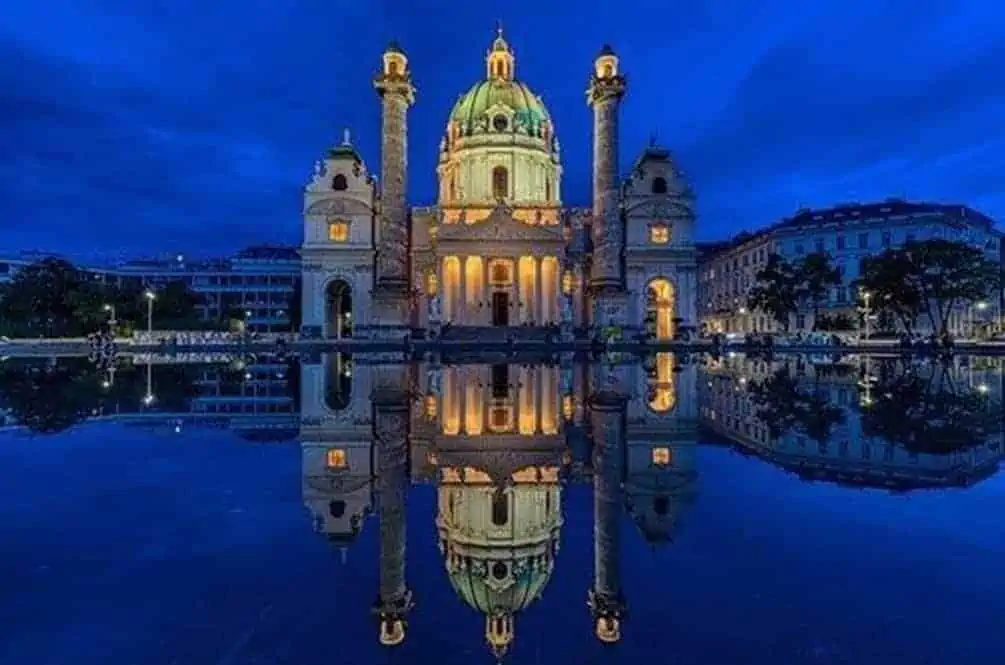
What was the reason for the construction of the Karlskirche and after which Karl is it named? Who was the architect and which other buildings can be traced back to him? What is special about the architecture of St. Charles Church, both inside and out? Baroque – Baroque – Karlskirche. A true masterpiece of Baroque architecture, built by the architect Johann Bernhard Fischer von Erlach . He was also responsible for the
Johann Bernhard Fischer von Erlach was awarded the contract ahead of his great rival Johann Lukas von Hildebrandt. The church is intended as a
The foundation stone was laid in 1716 on the right bank of the Vienna River, which was barely regulated at the time.
Charles Borromeo, patron saint of the emperor
A panoramic lift takes you up to a height of 32 meters in no time at all. The dome is actually shaped like an ellipse. From the side, at the entrance, it looks larger than from the front. The Karlskirche church on the square of the same name is a listed building. Nearby you will find the Vienna University of Technology (TU), the Naschmarkt, the Secession, the Albertina modern and the Musikverein as well as the Wien Museum (currently closed for renovation).
Not forgetting the two pavilions created by Otto Wagner, THE Viennese city architect around 1900. One pavilion houses a café, the other an exhibition on the life and work of Otto Wagner. On Karlsplatz is Resselpark with numerous statues, e.g. of Josef Ressel, who gave his name to the park and invented the ship’s propeller. A statue was also dedicated to Josef Madersperger in thanks for the invention of the sewing machine.
Time Travel Tip: For those with a head for heights: be sure to take the panoramic lift up the 32m to the top to admire the dome frescoes and the view from up close. It is particularly beautiful at Christmas time when the Christmas market of artisans takes place on Karlsplatz. The church concerts in the Karlskirche are highly recommended!
More info: Karlskirche Vienna | Vienna
Image source: https://pixabay.com/de/photos/karlskirche-wien-%C3%B6sterreich-4387053/