How long has the State Hall of the National Library existed and where were the collections housed in the past? Who commissioned the building and who was the architect? What is the role of the National Library today?
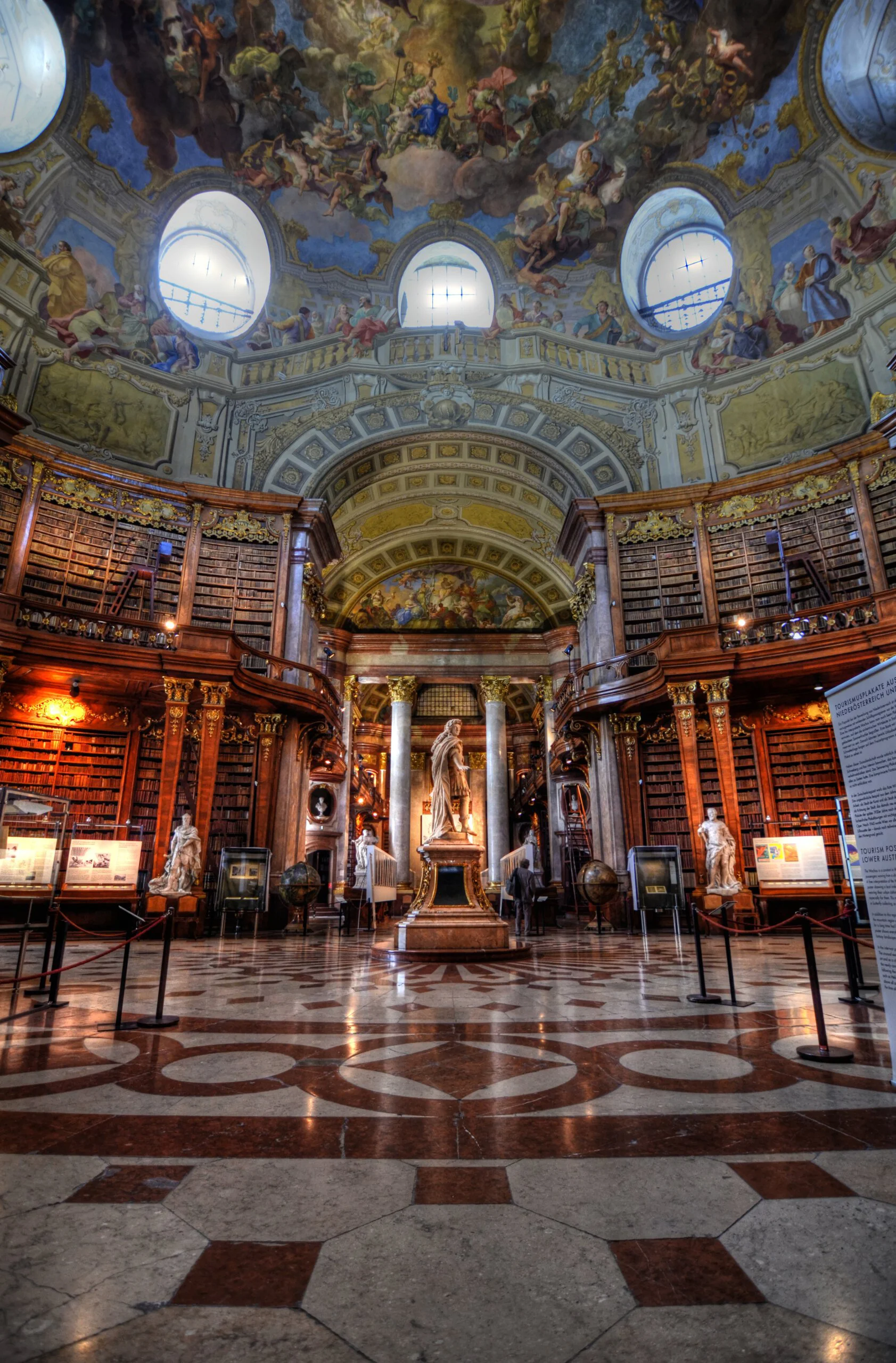
The State Hall of the Austrian National Library is one of the most beautiful baroque libraries in the world. It is located in the Hofburg building complex, the entrance is on Josefsplatz.
As you enter the State Hall, you can smell and feel the exciting history of Austria. Over
Court library commissioned by Emperor Charles VI.
The building, formerly known as the Court Library, was built at the beginning of the 18th century as part of the Hofburg. Emperor Charles VI (father of Maria Theresa) was the client and Fischer von Erlach father and son were responsible for the architecture. Work was begun in 1723 by father Johann Bernhard, and after his death his son Joseph Emanuel completed the building in 1726. The sculptures on the roof of the building are by Lorenzo Mattielli.
Inside, the Baroque fresco in the central dome by Daniel Gran is particularly impressive. It depicts an apotheosis of Emperor Charles VI , to whom a sculpture in the middle of the hall also pays homage. Two Venetian globes are no less impressive.
Collections & Archive
One of the main tasks of the Austrian National Library is to collect and archive all publications published in Austria. Books can be read on site in the historic Augustinian reading room . Through the ANNO project , historical newspapers and periodicals are scanned and can be accessed online.
It is estimated that the National Library holds a total of around 12 million items , of which 4 million books. Maps, incunabula, prints, old printed works, papyrus collection and music collection are also included.
With around 8,000 incunabula (printed books with movable type from the 15th century), the National Library has the fourth largest collection in the world. The picture archive is the largest picture documentation center in Austria with around 2 million objects.
The National Library can boast some special treasures . Among them is the Tabula Peutingeriana. This is a cartographic representation of the Roman road network, where Vindobona was already marked. This road map from the 12th century was named after Konrad Peutinger and is considered a UN World Documentary Heritage.
Another highlight is the magnificent “Golden Bull” manuscript . This governed the election of the German king by the seven electors. It was one of the most important documents of the Holy Roman Empire.
Present: A place to search for information
The library and reading rooms at Heldenplatz are mainly used by students and information seekers for their research.
The other museums of the Austrian National Library include:
- Literature Museum,
- Globe Museum (the only one in the world),
- Papyrus Museum,
- Esperanto Museum and
- since November 2018 – The House of Austrian History.
Where were the books stored in the past? Before the building was completed in 1726, the books were stored in the Minorite monastery. The first collections date back to the 14th century and were initially collected in various castles and monasteries.
Around 300 people are employed at the National Library.
Time Travel Tip: There are always interesting temporary exhibitions in the State Hall. Sometimes free admission on special days. A special experience is to borrow a book on site and read it in the historic Augustinian Reading Room.
More information: Homepage – Austrian National Library (onb.ac.at)
Image source: https://commons.wikimedia.org/wiki/File:State_Hall_of_the_Austrian_National_Library_NightFall404_1.jpg?uselang=pdc